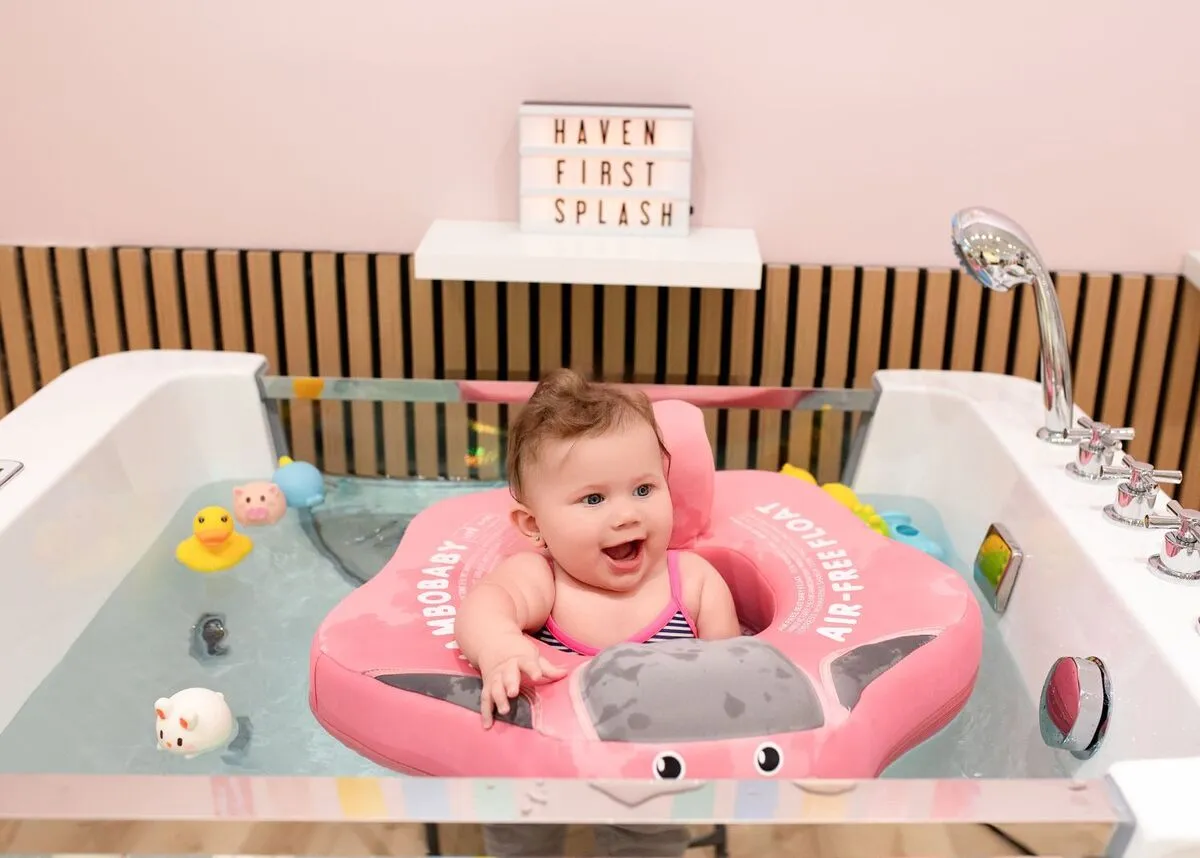
If you’re searching for baby hydrotherapy in London, Ontario, you probably already sense that warm water does something for babies that nothing else does. Newborns spent nine months suspended in fluid; the moment they’re back in warm, gentle water, you can see their bodies remember.
This guide explains what baby hydrotherapy is, what to expect from a session, what parents tend to notice afterwards, who it suits and who should check with a doctor first. It’s written by the team at Dolphin Dive Family Wellness, London’s first dedicated baby spa and family wellness centre.
What Is Baby Hydrotherapy?
Baby hydrotherapy, sometimes called infant hydrotherapy or a baby float, is a calm session in which an infant floats in a custom-designed tub of fresh, warm water. A soft neck float supports the baby’s head while their body moves freely: weightless, calm and unconstrained by gravity.
It’s a different experience from a bath. Bath water is task-oriented: get clean, get out. A float is unhurried. The water is temperature-controlled and deep enough to float, and your baby has time to settle and enjoy it.
At Dolphin Dive, baby hydrotherapy sessions are run by our experienced team, who work with babies every day. They are booked as 30 minute visits and designed for babies from 1 month to 3 years old.
Why Warm Water Feels So Calming
Three things happen at once when a baby enters warm water:
Buoyancy takes the weight off. Without the constant pull of gravity, babies who haven’t yet rolled, sat or crawled get to move freely on their own, often for the first time.
Gentle, even pressure. Warm water presses softly and evenly on the skin, a little like swaddling. It is one reason many babies calm within a minute or two.
Soft, predictable sensations. Water gives constant, gentle touch with no sudden surprises, which many babies find soothing after a busy, noisy day.
The Benefits, Explained
Here’s what parents in London tell us they notice. These are parents’ observations rather than proven medical outcomes, and every baby is different.
1. A Good Sleep Afterwards
The most common thing parents mention is a good nap or night’s sleep after a float. Warm water and gentle, whole-body movement tend to leave babies relaxed and pleasantly tired.
2. Comfort for Gassy, Fussy Babies
Many parents notice their baby passing gas or burping during or just after a float, and some find it a soothing option during the colic weeks. Hydrotherapy is not a medical treatment for colic, so please see your doctor about crying that worries you.
3. Free Movement
In the water, a baby can kick, twist, reach and stretch in ways they can’t yet manage on land, and parents love watching it. A float is play and movement, not a therapy for development. If you have questions about your baby’s milestones, talk to your doctor or our baby physiotherapist.
4. Warmth and Gentle Stretching
Warm water feels good, and floating lets your baby stretch out and move every joint on their own, with nobody moving them.
5. A Foundation for Water Confidence
Many families find that early, happy time in warm water makes later trips to the pool feel more familiar. A float isn’t a swimming lesson, but it gets your baby used to the feel of water on the body.
6. Sensory Regulation
For babies who run a little “hot” (easily overstimulated or hard to soothe), the warmth, gentle pressure and movement of the water are often calming. Many families tell us their weekly float becomes a reset for the whole week.
7. A Quiet, Connected Moment With Your Baby
There’s no phone, no list, no laundry. For 30 minutes, you watch your baby experience something they will never be able to describe to you, and many parents find they relax too. Parents tell us this is the part they didn’t expect to value most.
What a Session Actually Looks Like at Dolphin Dive
A baby hydrotherapy session at our London, Ontario studio runs about 30 minutes total. Here’s the rough flow:
Arrival and check-in (about 5 minutes). We greet you in our quiet reception area, walk you through what the session will look like, and answer any questions. If this is your baby’s first visit, we take a little extra time so neither of you feels rushed.
Preparation (about 5 minutes). We help you change your baby into a swim diaper, fit the soft neck float, and make sure the water temperature (between 35 and 37 °C, close to body temperature) is right for your baby’s age and comfort.
The float itself (about 15–20 minutes). Your baby enters the tub, and we stay close, watching their cues. Some babies start kicking immediately; others take a minute to settle and then drift into stillness. There’s no goal beyond letting them experience the water on their own terms.
Wind-down (about 5 minutes). We dry your baby in a warmed towel and give them a moment in your arms before you head out. Many babies fall asleep in the car on the way home.
If you’d like the full experience, our Baby Hydrotherapy & Massage Combo pairs a 30-minute float with a 30-minute RMT-led infant massage. The massage portion is eligible for coverage under many extended health insurance plans.
Who Should Try Baby Hydrotherapy (and Who Shouldn’t)
Baby floats suit healthy babies from 1 month old. Babies born preterm should reach an adjusted age of 1 month and be cleared by their doctor first.
Families often book a float for:
- Gassy or fussy babies
- Babies who find it hard to settle
- A calm first outing with a new baby
- A weekly ritual for parent and baby
- New parents looking for a calm, connected moment with their infant
Please check with your baby’s doctor before booking if your baby:
- Was born preterm (wait until an adjusted age of 1 month, with your doctor's OK)
- Has a developmental delay or low muscle tone
- Has a condition such as Down syndrome, cerebral palsy, spina bifida or spinal muscular atrophy
- Has any neck, spine, heart, breathing or neurological condition
- Has open wounds, fresh stitches or a skin infection
- Has a fever or recent illness
- Has just had vaccinations (we usually suggest waiting 24 to 48 hours)
Why we ask: a neck float is not a safety device, and health authorities, including the US Food and Drug Administration, advise against neck floats for babies with developmental delays or special needs. That is also why your baby is never left alone in the water. We always do a brief screening before your first session. If a float isn’t right for your baby on a given day, we’ll happily reschedule.
How Often Should You Book?
There’s no single right answer, and we don’t push passes on families who don’t need them. That said, here’s what most of our regulars settle into:
- Weekly for families who love it as part of their routine.
- Every other week as a calming family ritual.
- Monthly as a treat once the newborn weeks are behind you.
If you’re not sure, start with a single session and see how your baby responds in the 24 hours that follow. We’ll help you decide from there. Our Hydrotherapy Pass (book six floats, the seventh is free) makes repeat visits more affordable for families who find a rhythm that works.
What to Bring to Your First Visit
- A swim diaper (we don’t sell these on site, so bring your own).
- A change of clothes for baby.
- Optional: baby’s favourite towel or comfort item.
- A bottle or planned feed for after: many babies are hungry post-session.
We provide everything else: float equipment, sanitized tub, towels, organic oils for the combo session, and our full attention.
A Note on Safety and Hygiene
Every Dolphin Dive hydrotherapy session uses freshly drained and refilled water, no shared bath, ever. The tub is plumbed directly to hot and cold supply and drain, so it is emptied and refilled for every baby. No chlorine and no chemicals are added, and the water is held between 95 and 100 degrees Fahrenheit. Float equipment is sanitized between every session, and our staff are trained in infant CPR. If you ever want to see our cleaning protocol up close, just ask when you arrive.
Common Questions From London Parents
Is baby hydrotherapy the same as baby swimming?
No. Swimming lessons are about learning a skill. A float is a calm, supervised float with no lesson to learn: your baby simply gets to be in water that feels good.
Will my baby get water in their ears?
The neck float keeps your baby’s ears just above the waterline. We don’t submerge the baby’s head.
Can I bring siblings?
Older siblings are welcome in our reception area but, for safety and so your baby gets a calm experience, they don’t accompany you into the hydrotherapy suite. Parents do best when one adult is with the baby and any siblings are with another caregiver.
How is this different from a bath at home?
Water temperature, depth, duration, equipment, and supervision are all different. The experience comes from the combination, so recreating any one element at home is not the same.
Is the massage portion of the combo covered by insurance?
Yes. The 30-minute infant massage performed by our Registered Massage Therapists is eligible for coverage under most extended health benefits plans. Bring your receipt to submit to your insurer.
What the Research Says
Research on baby floats is still limited, so we don’t claim medical benefits for them. We offer floats as a calm, enjoyable experience for babies and parents. For water safety at home and at the pool, the Canadian Paediatric Society’s water safety guidance is a good place to start.
Book Your Baby’s First Hydrotherapy Session
If you’ve been looking for a way to give your baby, and yourself, a true moment of calm, this is it. Sessions run 30 minutes, are CA$50, and are available 1 month to 3 years.
Book the Hydrotherapy + Massage Combo →
Dolphin Dive Family Wellness is located at Unit 112, 1305 Commissioners Rd E, London, ON. Call us at (226) 984-8000 with any questions.